Capital Calendar | Philippine BPO Financing Guide
The Philippine BPO Capital Calendar: Why Your Client’s Fiscal Year Determines When You Need Working Capital
A 12-Month BPO Financing Guide for the Philippines
By Adriel Maniego · Updated June 23, 2026
The short version
A BPO's working capital is a payroll-to-collection gap, not an inventory problem. Its largest single cash event is December — 13th-month pay, magnified by headcount. And the timing of its biggest need, funding a ramp, is set not by its own calendar but by its clients': serving US clients points to an October financing window, UK clients to January, and Australian clients to April. The lender conversation starts before the need arrives. Capital readiness is a discipline, not an event.
Source & context: Industry context draws on the IT and Business Process Association of the Philippines (IBPAP), the apex organization for the Philippine IT-BPM sector. Adriel Maniego participated as a panel speaker at the IBPAP SME Roundtable, where the themes here were originally explored with industry operators (additional documentation).
About
Buhay Platforms Inc. is a SEC-registered fintech firm (Reg. No. 2025010186147-22) and a Manila Bulletin Newsmaker of the Year. 100+ financing deals supported nationwide. Network of 30+ financial institutions — commercial banks, rural banks, and non-bank financial institutions. Accredited by the Quezon City, Cebu, Metro Angeles, Pampanga, and Manila Chambers of Commerce and Industry.
Why Is Working Capital Tighter for a Philippine BPO Than the Financials Suggest?
On paper, a Philippine BPO looks like the cleanest borrower a lender could want. No inventory to finance. No commodity exposure. Recurring, contracted revenue from creditworthy offshore clients. And yet operators with healthy income statements run short of cash with a regularity that surprises them.
The reason is structural. A BPO's dominant cost is payroll, and payroll is paid now — twice a month, without exception. Its revenue arrives later, on offshore terms that commonly run thirty to sixty days from invoice, often in a foreign currency, after the client's own approval cycle. The gap between paying your people and being paid by your clients is the entire working-capital story. An inventory business borrows against stock; a BPO borrows against time.
Ramps stretch that gap to its widest. When you win a new account, you hire and train a cohort months before it produces a billable seat, and longer still before the first collection clears. For that stretch you carry full payroll against zero revenue on the new work. The faster you grow, the wider the gap — the uncomfortable arithmetic of a services business is that expansion consumes cash before it produces it.
The predictable thing about all of this is that it is predictable. The costs move on a calendar you can read a year out, and the capital need moves with them. This is the same discipline behind the SME Capital Calendar, applied to the particular cash cycle of a BPO. Which means the conversation with your lender belongs before the need arrives, not after — because a facility takes weeks to arrange and a ramp cannot wait for one.
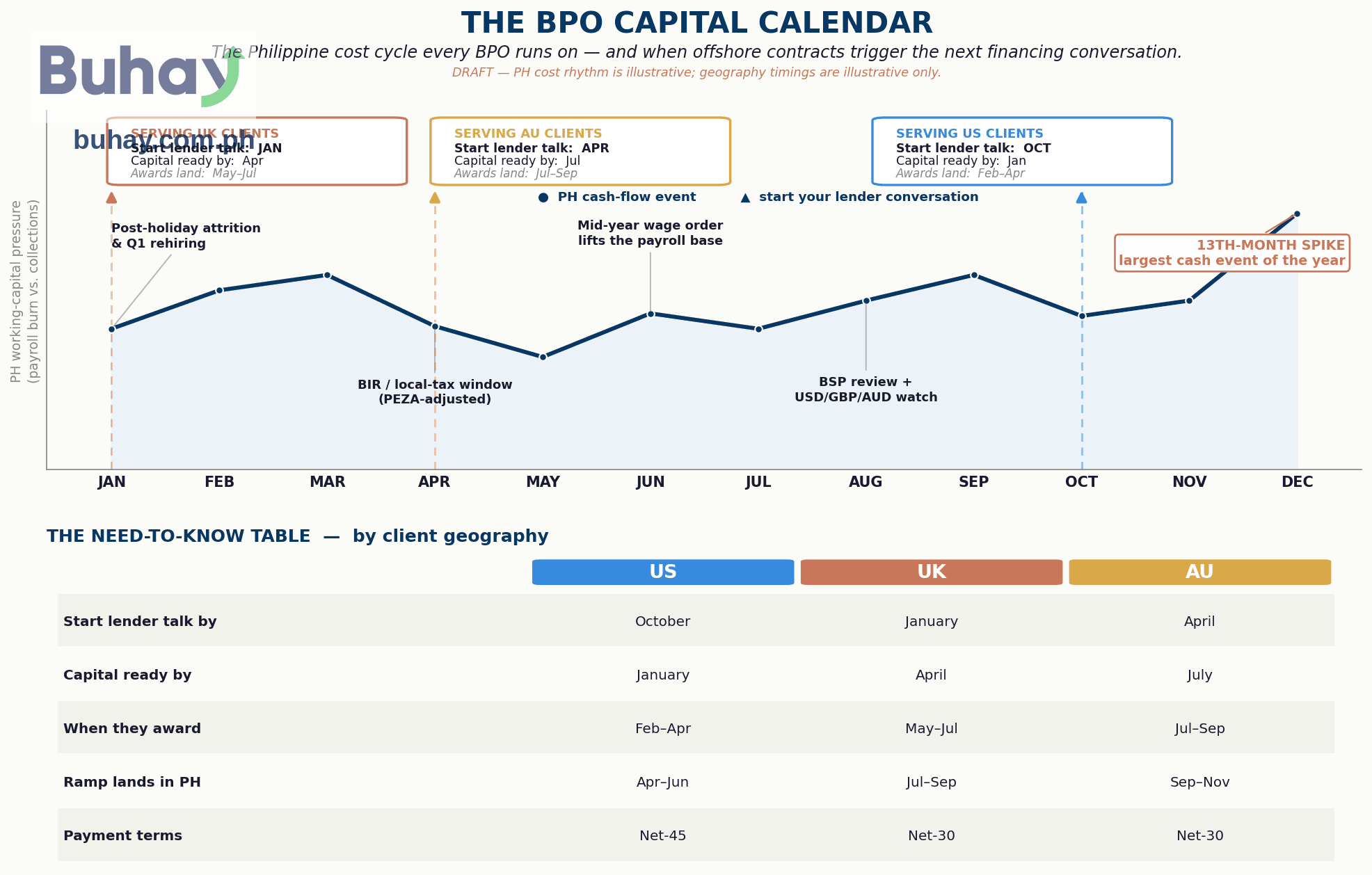
What Does the Philippine BPO Cost Year Look Like, Month by Month?
January. Attrition spikes after the holidays, clients lock next year's budgets, and you begin rehiring — all while cash is still recovering from December's outflow. The month feels tighter than the income statement suggests. Treat the dip as the trough before the Q1 ramps, not a trend, and use the quiet to plan the year.
February. The accounts you won late last year start ramping: you hire and train cohorts that earn nothing yet. This is where the payroll-to-collection gap opens — real money out, no new money in. If you are arranging the capital for this ramp now, you are already behind it.
March. Ramps hit their stride and the newest cohorts approach go-live as the quarter closes. Burn peaks before billing catches up. Watch the lag between a cohort going live and its first invoice clearing — that interval, not the headcount, is what your facility actually has to cover.
April. Tax season. If you are PEZA-registered on an income-tax holiday or the special 5% rate, national income tax may be light or exempt — but local business taxes, real-property tax, and other obligations still come due, and they catch the firms who assumed PEZA meant nothing lands in April. Confirm with your finance lead exactly which obligations apply under your incentive status; the exemption is narrower than most operators think.
May. Collections from the Q1 ramps arrive and the gap finally narrows — the year's first real breathing room. Spend it planning the second half, not relaxing. The mid-year wage adjustment is only weeks away.
June. Regional wage boards tend to issue their orders mid-year, and a labor-dominated cost base feels every peso of it. This is not a one-time hit; it is a permanent step-up in your largest expense. Model it into second-half unit economics before it lands — a margin you set in January may not survive July.
July. Cost is quiet; pipeline is loud. Mid-year client reviews drive renewal and expansion conversations. Remember that an expansion you agree to now becomes a Q4 ramp — so the capital math for it starts here, not in September when the burn arrives.
August. The rate-setting and currency windows matter more than they look. If you draw on a facility, the cost of that capital is shaped in these months by Bangko Sentral ng Pilipinas policy; if you earn in dollars, pounds, or Australian dollars against peso costs, the exchange rate is quietly setting your margin while you watch the policy rate. Both deserve a line in your planning.
September. A second ramp hump — for accounts going live before year-end — lands on top of year-end planning. Like the Q1 ramps, the capital for these should already be in place. September is a month to draw, not to start arranging.
October. Year-end planning and next-year renewals begin — and for any firm serving US clients, this is the month the financing clock starts (the next section explains why). The lead time you build now is what lets you ramp the moment a US award converts in the new year.
November. The calm before the largest outflow of the year. Push collections in before client offices wind down, and confirm your December coverage now. The worst time to discover a 13th-month gap is the second week of December.
December. Thirteenth-month pay and bonuses make this the single largest payroll event of the year — and in a headcount business, it scales with every seat. It collides with the slowest collection window, as offshore clients close for the holidays. Every operator sees it coming; too many still fund it late. The bridge for December should be arranged in October or November, not the week before payroll runs.
How Does Your Client's Fiscal Year Decide When a Philippine BPO Needs Capital?
Everything above is the cost cycle every Philippine BPO shares. But the single largest capital event in this business — funding a ramp — does not run on your calendar. It runs on your client's.
A new account travels a fixed path: the client approves a budget, issues a request for proposals, awards the contract, and only then do you ramp. By the time you have won the award, the hiring cannot wait for a facility to close. So the month you need capital ready is dictated by when your clients budget and award — a function of their fiscal year, not yours. That produces three distinct financing clocks.
United States clients run on the calendar year. Budgets are approved late in the prior year and awards land in the first quarter, so ramps follow in spring. To be ready, the lender conversation should start around October, with capital in place by January — before the award converts to hiring.
United Kingdom clients run an April-to-March year, with awards clustering after the spring budget. The conversation starts around January, with capital ready by April.
Australian clients run July to June, with awards in the second half. The conversation starts around April, with capital ready by July.
The operator serving one geography has one capital event a year. The operator serving all three has three, staggered across the calendar — and a secondary, year-end cluster of awards across all three markets drives a shared ramp in January and February that lands directly on top of December's 13th-month outflow. For a diversified BPO, the stretch from the fourth quarter into the first is the heaviest of the year.
This is the discipline made concrete. The calendar is not yours to set; it belongs to your clients. Reading it is the difference between the operator who ramps the day an award lands and the one who wins the work and then scrambles for the capital to deliver it.
Capital readiness is a discipline, not an event
None of this is about whether your business is good enough to finance. It is about whether the capital is in place on the day the ramp begins. The cost cycle is predictable a year out. The client calendars are knowable the moment you know which markets you serve. The only real variable is whether you have done the work before the need arrives.
The operators who scale from a single banking relationship to a portfolio of them are rarely the ones with dramatically better businesses. They are the ones who treated capital as something to arrange on a schedule, not to chase in a crisis.
“The calendar is not yours to set. It belongs to your clients — and reading it is the discipline.”
Mapping a BPO's cost cycle and its client geographies into a financing timeline — before the need arrives — is the core of our BPO advisory work. If you are planning next year's ramps, the time to build that timeline is now.
Frequently Asked Questions About Philippine BPO Financing
Four to six months before the capital is needed. A new facility takes weeks to arrange and a ramp cannot wait for one. For a Philippine BPO serving US clients, the conversation should begin in October to have capital in place by January. For UK clients, January with capital ready by April. For Australian clients, April with capital ready by July.
Because payroll is paid twice a month and revenue arrives on offshore terms of 30 to 60 days from invoice. A BPO's working capital is a payroll-to-collection gap, not an inventory problem. Ramps stretch that gap to its widest — cohorts are hired and trained months before they produce a billable seat, and longer before the first collection clears.
The 13th month obligation is the single largest payroll event of the year for a Philippine BPO and scales with every seat. It collides with the slowest collection window as offshore clients close for the holidays. The bridge facility for December should be arranged in October or November, not the week before payroll runs.
Not entirely. If you are PEZA-registered on an income-tax holiday or the special 5% rate, national income tax may be light or exempt — but local business taxes, real-property tax, and other obligations still come due in April. The exemption is narrower than most operators think. Confirm with your finance lead exactly which obligations apply under your incentive status.
Philippine BPOs are asset-light, USD-earning, and fuel-light in a high-fuel-cost, weak-peso macro — conditions where dollar revenue against peso costs expands margins. The revenue is recurring and contracted from creditworthy offshore clients. The gap between this operating profile and how institutional lenders price BPO risk is one of the most persistent mispricings in Philippine SME finance.
Key Takeaways
- US clients drive an October financing window. UK clients drive January. Australian clients drive April.
- The December 13th month bridge should be arranged in October or November — never the week before payroll runs.
- A BPO's capital calendar is set by its clients' fiscal years, not its own — reading both is the discipline.
Build Your BPO Capital Calendar With Buhay
Buhay maps a BPO's cost cycle and client geographies into a financing timeline, then identifies the right institutions for each window across a network of 30+ commercial banks, rural banks, and non-bank financial institutions. If you are planning next year's ramps, start with a complimentary BPO advisory assessment — or view active BPO deals in our pipeline.
Adriel Maniego
Founder & CEO, Buhay Platforms Inc.
Buhay — Manila Bulletin Newsmaker of the Year
Accredited, QC, Cebu, Metro Angeles, Pampanga & Manila Chambers
[email protected] · [email protected] · buhay.com.ph
SEC Reg. No. 2025010186147-22.
This article is for general informational purposes and does not constitute financial, legal, tax, or investment advice. Cost-cycle timing and client-geography windows are illustrative and will vary by company, incentive status, and client mix. Consult qualified professionals before making financing decisions. © 2026 Buhay Platforms Inc.